ABOUT THE CONFERENCE
WHEN AND WHERE
|
The 12th IAP Asia-Pacific Regional Conference 2026 will take place at the Convention Center Bharat Mandapam in New Delhi, India, from 11th March 2026 to 13th March 2026. The All India Prosecutors Association (AIPA) will be hosting the conference. The Bharat Mandapam, at the IECC complex, Pragati Maidan, New Delhi will serve as the primary venue of the conference. It is a world-class venue that hosted the historic G20 summit and its global leaders. It is a sprawling, state-of-the-art facility whose architecture draws inspiration from India’s rich indigenous cultural heritage. Situated close to the centre of the city, it is a premier venue that aligns with India’s vision of global outreach and hospitality. |
 |
ABOUT THE VENUE
NEW DELHI, INDIA
India is a vast subcontinent in South Asia, spanning from the sky-high Himalayan peaks to the tropical shores of the Indian Ocean in the South. It is one of the world’s ancient civilisations, and a land of profound diversity, housing a rich and complex mix of cultures, traditions, languages, faiths and people. Today, it is a modern nation, reflecting vibrance and celebrated for its breathtaking landscapes, brewing energy and youthful exuberance.
Being the world’s largest democracy, India is a Federal Parliamentary Democratic Republic. The Constitution of India is the beating heart of the Democratic system, serving as the supreme source of law. Law here is built on the foundation of legislation, subsidiary rules, and binding precedents established by its independent judiciary.
ABOUT THE ALL-INDIA PROSECUTORS ASSOCIATION
The All-India Prosecutors Association is the only platform nationally that unites cadre prosecutors from every State and Union Territory across India. Its mission is primarily to empower prosecutors all over the country to connect, collaborate and be leaders in a globalised legal landscape, fostering justice, unity and excellence without borders.
Prosecution is a subject under the concurrent list in the Indian Constitution, resulting in each State operating its own independent Directorate of Prosecution. This enables decentralised administration; however, there was a dire need for a cohesive national structure to better represent the common interests of the prosecutors. In today’s rapidly evolving environment, where technology has erased boundaries and crime has become increasingly transnational —including cybercrime, economic offences, and organised crime—prosecution challenges demand seamless inter-state coordination and global engagement.
AIPA has emerged as the singular national voice and central coordinating platform to meet this need. AIPA provides a collective voice on service conditions, rights, and professional issues of the prosecutorial community. Inter-state cooperation and dialogue, mutual learning across jurisdictions, the welfare, training and professional growth of members through conferences and capacity-building programs are at the heart of AIPA’s goals.
Further, AIPA forges robust international linkages. As the officially designated contact body with the International Association of Prosecutors, The Hague, AIPA plays a key role in ensuring India’s active presence in the global prosecutorial landscape. This recognition, formalised in 2022, allows AIPA to bring global best practices closer to India’s judicial system. In essence, AIPA is much more than an association; it is a movement dedicated to uniting prosecutors and strengthening prosecutorial excellence across India and beyond.
ABOUT THE IAP
GENERAL INFORMATION ABOUT THE IAP
The International Association of Prosecutors (IAP) serves as the only worldwide association of prosecutors. It was founded in June 1995 at the United Nations offices in Vienna.
Its membership includes 180 organisational members, and its influence spans 170+ countries, territories, and states. The IAP also has numerous individual members within the organisation's ambit.
The primary goal of creating the IAP was to ensure a united prosecutorial response to the rapid growth of serious transnational crimes, including drug-trafficking, money laundering and fraud, amongst several others.
The Executive Committee of the IAP serves as the management and administrative body, while the Senate acts as an advisory body in the governance of the IAP. The Secretariat, headquartered in The Hague, The Netherlands, manages the organisation's day-to-day operations.
The IAP serves as a professional, ethical, and cooperative international community for prosecutors worldwide.
IAP OBJECTIVES
The IAP Constitution sets out the following Objects of the IAP:
1. To promote the effective, fair, impartial and efficient prosecution of criminal offences.
2. To respect and seek to protect human rights as laid down in the Universal Declaration of Human Rights proclaimed by the General Assembly of the United Nations on 10 December 1948.
3. To promote high standards and principles in the administration of criminal justice, including procedures to guard against or address miscarriages, in support of the rule of law.
4. To promote and enhance those standards and principles which are generally recognised internationally as necessary for the proper and independent prosecution of offences.
5. To assist prosecutors internationally in the fight against organised or other serious crime, and for that purpose:
-
-
- to promote international cooperation in gathering and providing evidence; in tracking, seizing and forfeiting the proceeds of serious crime; in the prosecution of fugitive criminals;
- to promote speed and efficiency in such international cooperation
-
6. To promote measures for the elimination of corruption in public administration.
7. To promote the professional interests of prosecutors and to enhance recognition of their crucial role in achieving criminal justice.
8. To promote good relations between individual prosecutors and prosecution agencies; to facilitate the exchange and dissemination among them of information, expertise and experience; and, to that end, to encourage the use of information technology.
9. To promote examination of comparative criminal law and procedure and to assist prosecutors engaged in justice reform projects.
10. To cooperate with international juridical organisations in furtherance of the foregoing objects.
IAP OFFICERS AND ORGANS
The Executive Committee is the governing body of the IAP, subject to the authority of the General Meeting which is the body of supreme authority in the IAP. The IAP elects a President, up to nine Vice-Presidents and up to twenty-one ordinary members of the Executive Committee. The membership of the Executive Committee reflects the regions in the world where the IAP has members.
The Executive Committee appoints a Secretary-General, who is the Chief Executive, a General Counsel, who is the principal professional representative responsible for the professional programme of the IAP and who provides legal advice and counselling to the IAP, and an Executive Director, responsible for the day-to-day management of the IAP, to include finances, technical support, communication, membership administration and community outreach.
The Senate of the IAP consists of past members of the Executive Committee who elect to join the Senate upon their departure from the Executive Committee, and who are, in the opinion of the President and the Executive Committee, fit and proper persons of good standing and repute in the Association. The Senate operates in conjunction with the President and the Executive Committee. The Senate serves as an advisory body and executes powers to promote the IAP Objects.
The Secretariat of the IAP is based in The Hague, The Netherlands.
IAP EXECUTIVE COMMITTEE 2025 - 2026
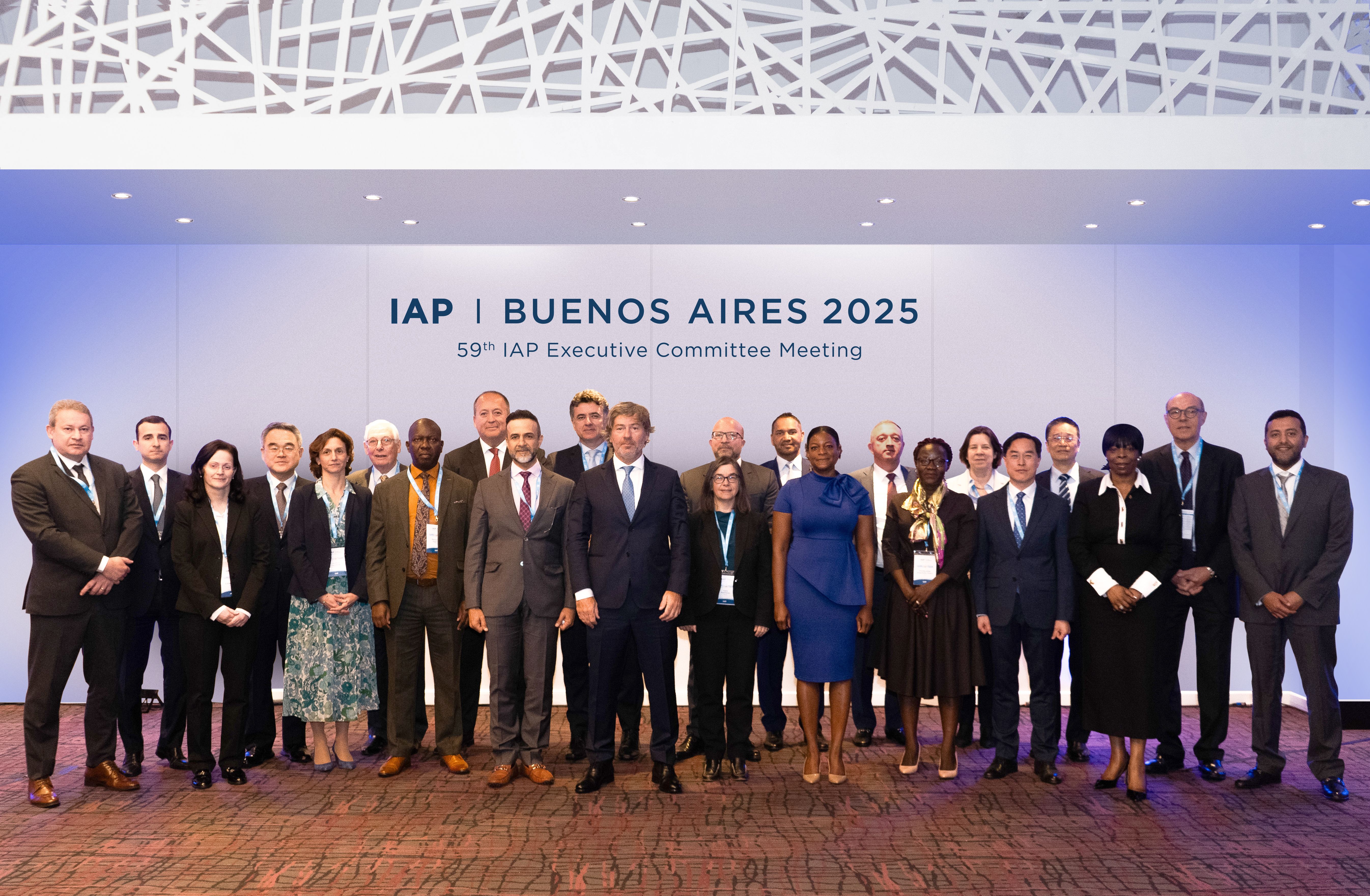
| President | |
| Juan Bautista Mahiques, Attorney General of the Autonomous City of Buenos Aires, Argentina | |
| Vice-Presidents | |
| 1. | Kamran Aliyev, Prosecutor General of the Republic of Azerbaijan |
| 2. | Shamila Batohi, National Director of Public Prosecutions, South Africa |
| 3. | Sally Dowling SC, Director of Public Prosecutions, NSW, Australia |
| 4. | Manuel Pinheiro Freitas, Director General of the Superior Law School of the Public Prosecution, Brazil |
| 5. | Giorgi Gogadze, Former Deputy Chief Prosecutor, Georgia |
| 6. | Michael Leitner, Deputy Procurator General, Austria |
| 7. | Nayef Mahmood, Senior Advocate General, Bahrain |
| 7. | Kate Matthews, President of CACC, Canada |
| 8. | Tong Jianming, First Deputy Prosecutor General, Supreme People's Procuratorate of People's Republic of China. |
| Immediate Past President | |
|
Cheol-Kyu Hwang, Chair Professor of Myongji University and Attorney at Law |
|
| Ordinary Members of the Executive Committee | |
| 1. | Jane Abodo, Former Director of Public Prosecutions, Uganda |
| 2. | Rashid Ahmine, Director of Public Prosecutions, Mauritius |
| 3. | Mohammed Hassan AbdulRahim, Advocate General, Dubai, United Arab Emirates |
| 4. | Abdulaziz Farhad Alqorony, Prosecutor, Public Prosecutions, Kingdom of Saudi Arabia |
| 5. | Immaculate Angutoko Draru, President, Uganda Association of Prosecutors |
| 6. | Stefan Blättler, Attorney General, Switzerland |
| 7. | Tsz King Chang, Former Prosecutor General, Macao SAR of PRC |
| 8. | Cindy Clarke, Director of Public Prosecutions, Bermuda |
| 9. | George Dolhai, Director of Public Prosecutions and Deputy Attorney General, Canada |
| 10. | Renato Finocchi Ghersi, Former Advocate General, Italy |
| 11. | Renson Mulele Ingonga, Director of Public Prosecutions, Kenya |
| 12. | Jeanette Manning, Director of NAGTRI, United States of America |
| 13. | Manoel Victor Sereni Murietta e Tavares, Public Prosecutor, State of Pará, Brazil |
| 14. |
Grace Ononiwu CBE, Director General Legal Delivery, CPS, England and Wales |
| 15. | Laureline Peyrefitte, Director of Criminal Affairs and Pardons, MoJ, France |
| 16. | Catherine Pierse, Director of Public Prosecutions, Ireland |
| 17. | Phairach Pornsomboonsiri, Former Attorney General, Thailand |
| 18. | Edina Soltesz, Public Prosecutor, Head of Division for International Cooperation, Hungary |
| 19. | Angel Valencia, Prosecutor General, Chile |
| 20. | Anna Vardapetyan, Prosecutor General, Armenia |